
Most people flock to San Telmo on Sundays for its weekly feria, but this historic barrio is worth visiting every day of the week.
In fact, some things like the best museums in San Telmo or historic shops that are closed on weekends, are best seen on weekdays.
This is the oldest neighborhood in the city and one I’m particularly fond of. It was my first home here when I moved to Buenos Aires in 2010. Whenever I have a chance to wander the city, I always find myself here.
This article is a complete guide to things to do in San Telmo, my favorite corner of the city.

QUICK NOTE: This post contains affiliate links and Sol Salute may receive a commission for purchases made through these links, at no extra cost to you.
How to get to San Telmo, Buenos Aires
San Telmo is in the heart of Buenos Aires just south of Plaza de Mayo.
Nit pickers will notice that some of the things in this guide are technically in the neighborhood of Montserrat, not San Telmo. But since you’ll visit them as part of your visit to San Telmo, I’m clumsily (and practically) including it all in this San Telmo guide.
I usually recommend starting your visit right there in Plaza de Mayo to see the sights there, like the Casa Rosada and the cathedral. Then walk through San Telmo on foot. I’ll list out the best things to do in San Telmo below in that order.
If you follow my advice and start in Plaza de Mayo, then the best public transportation option to get there is the metro system (called the Subte in Buenos Aires). Take Line D to the Catedral terminal or Line A to the Plaza de Mayo terminal.
If you want to begin in the heart of San Telmo, take an Uber or taxi to Plaza Dorrego and explore from there.
If you want to take a bus directly to the heart of San Telmo, they will mostly all drop you off on Avenida Paseo Colón. There are a lot of buses to choose from, but the 152 is generally the easiest for tourists or new residents since it hits up all the main sites from Palermo to Recoleta to San Telmo before ending in La Boca. Follow the route in Google Maps to make sure you don’t miss your stop (but if the bus is empty and you tell your bus driver where you’re going and ask for help, they’ll tell you).
Map of San Telmo Things to Do
I’ve pinned all of the things to do in San Telmo onto the Google Map below.
If you want something more interactive that you can follow along with on your phone, then I highly recommend my Buenos Aires City Map. It gives you access to my map of 330+ pins across the city including 10 self guided walks through the city.
History of Buenos Aires’ San Telmo
San Telmo is the oldest of Buenos Aires’ 48 neighborhoods and it still holds some of its original bohemian charm.
San Telmo gets its name from San Pedro González Telmo, the patron saint of sailors. In 1748, the Jesuits began construction on the Iglesia de Nuestra Señora de Belén and a spiritual retreat house here. Due to their presence the area was even referred to as “La Residencia” but when they were expelled from the region the Bethlehemites took over construction of the church and the residence was used as a jail.
The district continued to grow through the 18th century and was originally called “Alto de San Pedro” (San Pedro Heights) due its elevated position.
Many traditional aristocratic families lived in San Telmo, like Jose Echeverría and Domingo French. This was an artistic, bohemian neighborhood with large single family homes marked by high ceilings and multiple interior courtyards.
This continued until the 1871 yellow fever outbreak changed the face of the entire city. The illness struck densely populated districts like San Telmo and La Boca hardest, so the wealthiest residents fled to areas like Recoleta that, at the time, were north of the city.
In the coming decades, the abandoned homes for rented or taken over by poor immigrant families and turned into tenement housing called conventillos. Entire families occupied a bedroom and multiple families shared the common spaces. The timing coincided with Argentina’s largest wave of European immigration at the turn of the 20th century.
Today the neighborhood holds onto its original bohemian feel, with artists and tango houses like El Viejo Almacen decorating the barrio. It swells with life on Sundays for its weekly open air market but is a wonderful neighborhood to wander and get lost in all week.


Things to do in San Telmo, Buenos Aires
Here are the best things to do in San Telmo. I’ll put these things in order starting from Plaza de Mayo and working southwards so you can go on your own self guided walking tour.
Manzana de las Luces: The Illuminated Block
One block in from Plaza de Mayo you’ll find the Basilica de San Francisco.
If you hang a right at the historical pharmacy on Alsina and walk two blocks you’ll find the Illuminated Block (or Manzana de las Luces), named for the intellectual institutions that occupy the block.
The streets that form the block are Alsina, Peru, Moreno, Bolivar and Avenida Julio A. Roca. I’ve highlighted the block in yellow on the Google Map above.
The institutions include the Colegio Nacional de Buenos Aires (the most prestigious secondary school in the country), the San Ignacio church, and the old Buenos Aires University building, among others.


Librería de Avila
In a city that’s famous for its bookstores, this is the oldest in the entire city. A bookstore of sorts has stood on this corner since 1785, originally an apothecary that sold imports including books called “La Botica.”
Many of Argentina’s founding fathers, including Manuel Belgrano, Mariano Moreno, Juan José Castelli, and Juan José Paso, would visit the shop for clandestine texts and to debate political ideas before the May Revolution in 1810.
In 1875, it changed names to the Librería del Colegio, in response to the country’s most prestigious national high school across the street.
Today the bookstore is named after Miguel Ávila, who saved the shop from ruin in 1994. The shop has a wide selection of antique books as well as new but unique volumes about Argentina culture and history you typically won’t find elsewhere.


Buenos Aires Museo
This museum, just one block from Plaza de Mayo, is dedicated to the history and culture of Buenos Aires.
It’s in a historic building, one of the few in the city that remain without an “ochava”, where there is no diagonal in the corner of the building to improve visibility.
When you visit don’t miss going to the rooftop terrace where you can view murals on neighboring buildings painted in conjunction with this museum.
Click here to confirm opening hours and entry fees.


Farmacia La Estrella
Just one block away from the oldest bookstore is the country’s oldest pharmacy. La Estrella was founded in 1834 under the orders of President Bernardino Rivadavia.
Go inside, but confirm opening hours first. It’s typically only open Monday through Friday (so no luck if you only go for Sunday’s feria). You’ll see walnut shelves, Murano glass, marble counters and intricate murals painted on the ceiling overhead.
Its history goes beyond just being a pharmacy. In the 19th century political figures like Julio Argentino Roca, Carlos Pellegrini and Hipólito Yrigoyen to debate the future of the new nation.
In the 1860’s Melville Bagley (also the founder of one of the country’s biggest cookie brands) created Hesperidina right here, originally a cough syrup but now a digestif.
The pharmacists from La Estrella are also privileged to apply injections and vaccines in the Casa Rosada, including to the president him/herself.
This pharmacy was also the first to process cotton from the province Chaco for medicinal use, Algodón Estrella is still a brand of cotton balls that you can find nationwide. Just have a look in any supermarket or pharmacy!
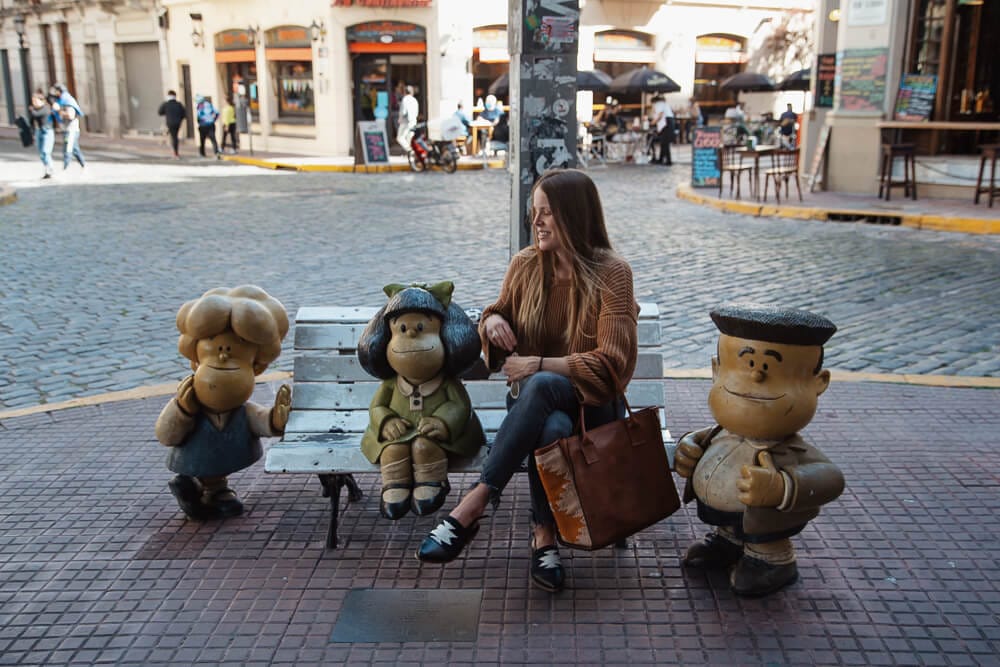
Take a Picture with Mafalda
Comic strips form a major part of the cultural fabric of Argentina.
There’s a statue of the most famous Argentine character Mafalda at the intersection of Defensa and Chile streets.
If you want the cliche San Telmo picture then you have to take a picture sitting with Mafalda.
On Sundays you will probably have to wait in line but during the week there will be no one here to get in your way.
Read my guide all about Mafalda in San Telmo to learn about her importance in Argentina.


Paseo de la Historieta
Mafalda doesn’t stand alone in San Telmo, she forms part of the Paseo de la Historieta, a walk through Argentina’s most iconic comic strip characters.
Statues of each character are placed throughout the neighborhood and it can make for a fun walk, click here for the route and more information.
Tour the El Zanjon de Granados Tunnels
When Jorge Eckstein bought this land in 1986 he had plans for a restaurant. What he discovered was centuries of history buried below street level.
Buenos Aires was built on a series of creeks and river tributaries and this museum tours the tunnels built to accommodate them.
The tour takes 50 minutes and is worth every second. Click here for hours and tour information.
The building is gorgeous and the tour is very interesting.
There are artifacts on display in the basement museum but the highlight is the tunnels that run below the entire block.
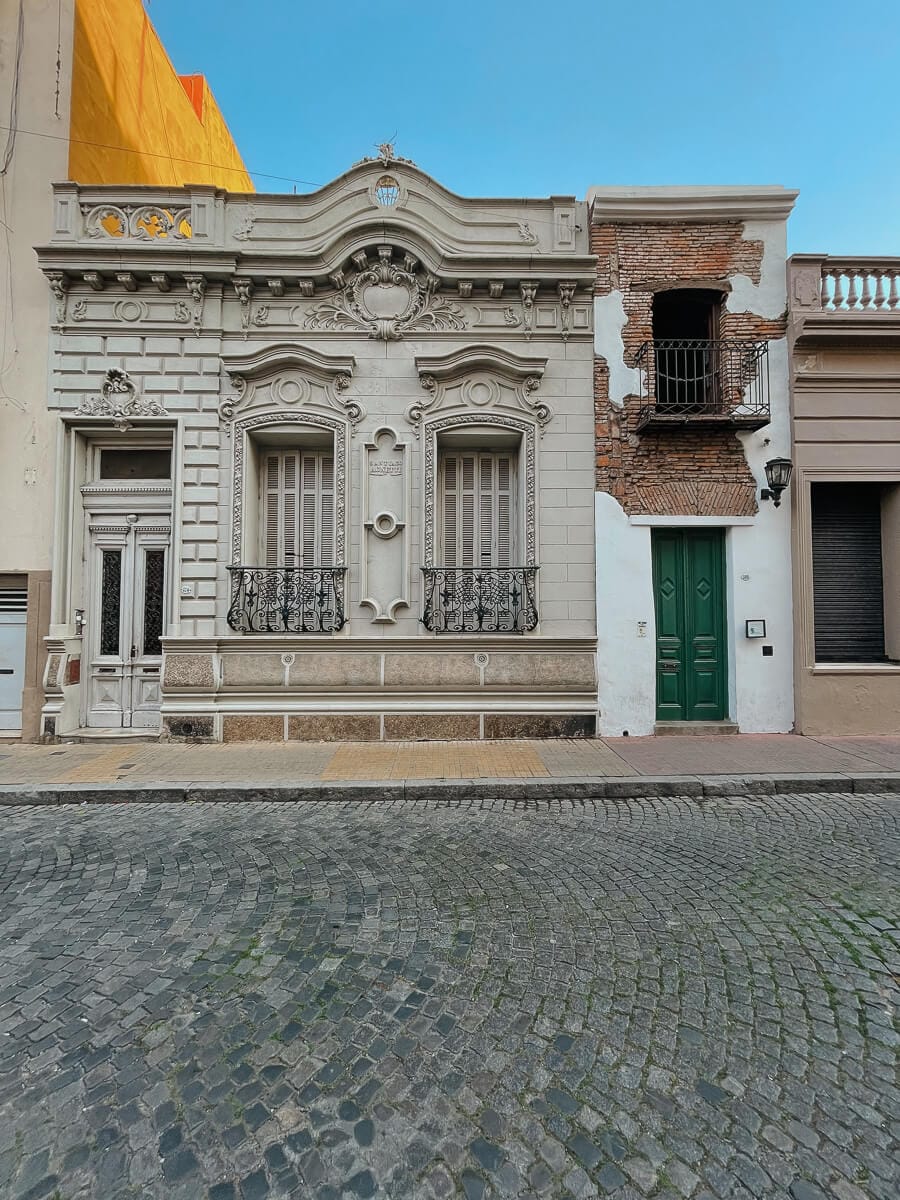

La Casa Minima
📍San Lorenzo 380 (in front of the El Zanjon tunnels entrance)
The narrowest house in the city is just meters from the Zanjon de Granados.
In 2018 the house was remodeled and opened for tours.
Legend has it that after the owner of the main house emancipated his slave, he gifted him with this sliver of land to build his home.
The tour isn’t the most exciting, mostly taking place in the building next door (understandably one can only spend so much time in the narrowest house in town). But it is a good addition to the Zanjon de Granados tunnels which form part of the same historical complex.
Check here under guided visits for prices and tour times. Plan in advance. While the Zanjon de Granados has multiple daily tours, there is only one per day for Casa Minima during the week and two daily over the weekend.


Mercado de San Telmo
This indoor market (not to be confused with the open air Sunday feria) opened in 1897 as a produce market to accommodate the new wave of immigrants arriving from Europe.
The structure was completely restored in 2022 and retains all of its original beams, arches, metal columns and tin and glass roof.
The Mercado de San Telmo is open daily from 9 am to 8 pm.
It partially retains its original function as a market but (sadly, in my personal opinion) it’s slowly becoming more of a food hall filled with touristy restaurants serving up empanadas, pasta, steaks and even tacos.
When I moved to Buenos Aires in 2010 it was 100% just a market – home to stalls selling only produce, grocery staples, and some of the city’s best antiques. I lived one block away and did my shopping here.
Some of these original stalls still remain, so please, go shop with them. Keep them going, they have beautiful vintage clothing, dishes, and other fun treasures.


Watch Tango Dancers in Plaza Dorrego
Plaza Dorrego is the spot where in September of 1816 gathered to announce Argentina’s Independence declared her independence on July 9th of that year at the Congress of Tucuman.
Today it’s the beating heart of San Telmo, lined with cafes and restaurants. If you want to see tango but don’t want to go to a proper show, then sit for a beer or coffee at one of the tables here to watch the street performers. Don’t forget to toss some pesos into their hat for a tip.
If you’d prefer a proper show, my favorite San Telmo show is El Viejo Almacen. Go for the show, not the dinner. I recommend going to La Brigada for a quick steak before the show, instead.
On Sundays, Plaza Dorrego is filled with antique stalls for the weekly market. The weekly feria lines all of Defensa Street but this is where you’ll find the antiques. At the end of the day each Sunday there’s a milonga here, with locals dancing tango at the back of the square. It’s a great way to see authentic tango.


Pasaje de la Defensa
One of my favorite not-so-hidden secrets of San Telmo is the Pasaje de la Defensa. This historic mansion, built in 1876, was the home of the aristocratic Ezeiza family.
This is a classic “Casa Chorizo”, named for its linear structure, the connecting rooms resembling links of sausage. The home is two stories with three interior patios.
Wealthy families in Buenos Aires’ densely populated southern neighborhoods abandoned their homes during the Yellow Fever Epidemic and the Ezeiza family was no different. After serving as a single family home this building has had a few different lives.
In 1910 it served as a primary school, then later as the National Institute for the Deaf. Then in 1930 it became a classic conventillo, with rooms rented to house 32 different families at once.
Today it’s a commercial space. Go in to see an example of Buenos Aires’ aristocratic homes. There are shops and cafes but you don’t need to consume or shop to wander the space.


Parque Lezama: the National History Museum, Russian Orthodox cathedral & Historic Cafes
Parque Lezama is one of the oldest parks in Buenos Aires but it was originally the gardens of the Lezama’s private estate.
It’s a beautiful park to rest your feet or stroll the footpaths crossing its rolling hills and embankments.
On the western side of the park visit the free National Historic Museum, open since 1897. The building was the original home of the Lezama family. The museum houses artifacts that were vital in Argentina’s history and fight for independence. It’s a must-visit for history lovers. Entrance is free and it’s typically closed Mondays and Tuesdays, confirm hours here.
On the northern side of the park across Brasil Street, you can’t miss the bright blue domes of the Russian Orthodox Cathedral of the Most Holy Trinity. One of two Russian Orthodox churches in the city, it’s not open to the public except for once monthly guided tours. They advertise the tours on their Instagram account the month prior and spots fill quickly, pay attention to their stories if interested.
Hungry? Cross the street from the history museum to Avenida Caseros. The two blocks of this avenue are perfectly preserved and there are a number of great restaurants on both sides of both blocks. Napoles is one of the most popular, filled with the owner’s massive antique collection.
There are also two historic bares notables on the corner of Brasil and Defensa streets on the corner of Parque Lezama: Bar Hipopótamo and Bar Britanico.


Where to eat in San Telmo
- 🥩Desnivel | Defensa 855 | It may look kitschy and touristy but the food is incredible. Order one of the lomo (tenderloin) dishes. My favorite is the Lomo a la Mostaza, tenderloin in a mustard cream sauce, my husband prefers the lomo a la pimienta (with pepper kernels)
- 🥩La Brigada | Estados Unidos 465 | Just around the corner from Desnivel, La Brigada is an institution. Waiters cut every piece of meat they bring to you with a spoon, it’s that tender. Football memorabilia wallpaper the dining room adding to the ambiance.
- 🥟El Gauchito | Av. Independencia 414 | My favorite empanadas in the entire city.
- 🍷Atis Bar | Peru 1024 | The food here is just ok but the setting is stunning, it’s an old convent and it’s worth going to see the space alone. Grab a coffee or beer to rest your feet.
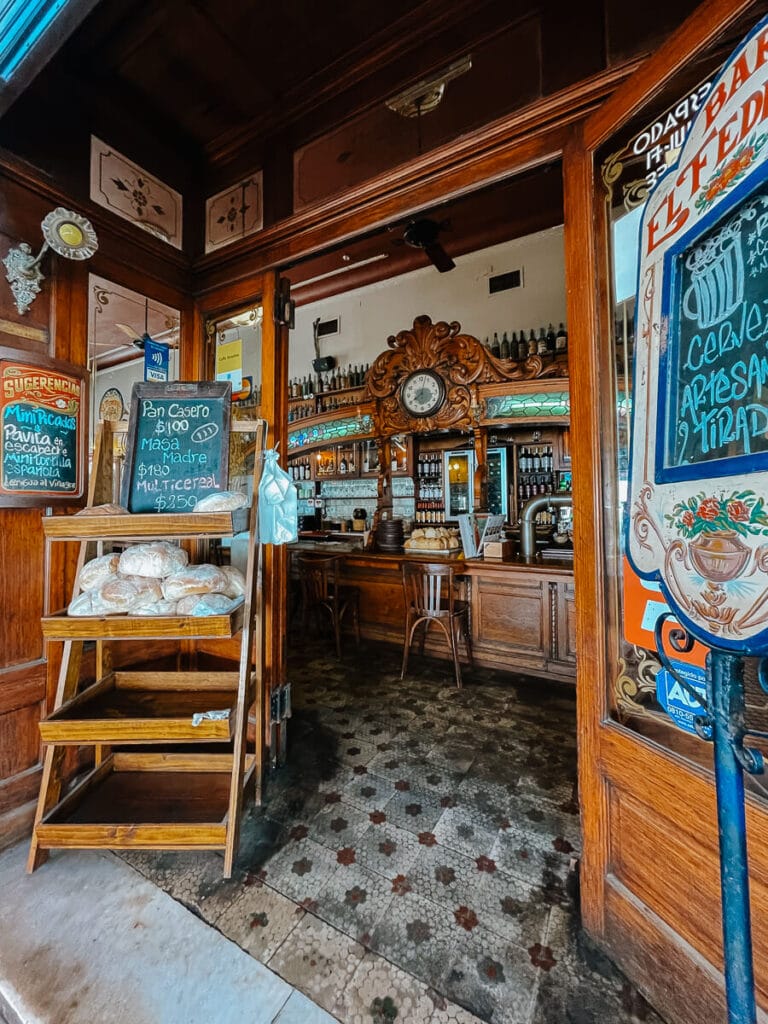
- ☕El Federal | Carlos Calvo 599 | Worth a stop even if you aren’t hungry, just come and have a sidra tirada (cider) and enjoy the vibe. But if you’re hungry, order a picada (a charcuterie plate). They’re incredible here.
- Want more recommendations? I have even more restaurants and hidden gems pinned to my map on Rexby, click here to gain access to all of my favorite restaurants and sites in the city. It includes 10 days of city walks and itineraries as well (that’s your trip planned!).

Where to stay in San Telmo
San Telmo is a great neighborhood to base yourself in. It has a relaxed, bohemian vibe, plenty of dining options to keep you busy, and you’re walking distance to a lot of major sites.
- Best Hotel in San Telmo – This Hilton property on Plaza Dorrego has a fantastic location and offers more amenities like breakfast, a gym, and a rooftop pool.
- Historic Boutique Hotel – Affordable and gorgeous boutique hotel in a historic building just a couple blocks from Parque Lezama.
- Historic Home – Rent an apartment or home in a historic San Telmo building for more comfort.
- Viajero Hostel – This hostel is great for solo or social travelers, plug into their many activities to meet people and explore the city.
- For more read my complete guide on where to stay in Buenos Aires
Read more about Buenos Aires
- A guide to La Boca, Buenos Aires – It’s common to combine San Telmo and La Boca in the same day, so hop a taxi to La Boca
- A Self-Guided Walk of Avenida de Mayo – Or combine your visit to San Telmo with nearby Plaza de Mayo and Avenida de Mayo
- Where to stay in Buenos Aires
- The Best Buenos Aires Bike Tours
- The Best Buenos Aires Food Tours
- The Best Steakhouses in Buenos Aires
Health Insurance Requirement
Foreign travelers are currently required to have travel medical insurance. While agents are still figuring out enforcement, they could deny you entry if you do not meet the requirement. Also, requirements aside, medical insurance is always a good idea when you travel.
SafetyWing’s Essential Plan meets all of the requirements Argentina is asking for (think hospital stays or antibiotics). It also covers lost luggage, travel delays and evacuations. Click here for more information to avoid future headaches.
Argentina Travel Resources
- BOOK A CONSULTATION | I offer one-on-one travel consultations to help you plan your trip to Argentina. Pick my brain to get a local’s insight. Click here for more information.
- ☕BUY ME A COFFEE | If you’ve enjoyed my blog and found it useful, you can buy me “virtual” coffee.
- MY MAP | Buy my interactive map with 300+ pins to have access to the city as I see it. It is an invaluable resource. See more here about how it works.
- AIRPORT TRANSFERS | Having a driver waiting for you is ideal for a stress free arrival, Cesar and his team here is the best option for a driver from Ezeiza or Aeroparque, they are my go-to airport ride!
- TRAVEL INSURANCE | Always travel insured. Anything can happen anywhere and it is scarier and costlier in an unfamiliar country. SafetyWing’s Essential Plan covers unexpected travel and medical emergencies and even offers add-ons like electronics theft or adventure sports. It is the best if you’re coming on vacation. If you’re coming as a digital nomad or an extended stay, you need their Complete Nomad Plan which also covers routine check ups, maternity, mental healthcare and more. Read more: Health Insurance in Argentina
- PHONE PLAN | These days, traveling with data is essential. Especially in Argentina where everything is managed on Instagram and WhatsApp. I recommend this E-SIM card. It’s hassle-free and affordable, for more read how to get an Argentina sim card.
- ACCOMMODATION IN ARGENTINA | booking.com is the most common hotel site used in Argentina and it’s where you’ll find the most options.
- RENTAL CARS | I love using Discover Cars, it is a great platform to compare different rates and providers and I find they have responsive customer service.
- BUS TICKETS | Check Busbud for long distance bus routes and tickets.
- VPN | If you’ll be using a public WiFi connection and want to secure your data, I highly recommend using a VPN, I personally use and have had a good experience with ExpressVPN. I also use it to access Hulu and American Netflix from Argentina.
- FLIGHTS | Always check Google Flights and Skyscanner for flights to and within Argentina. Aerolineas Argentina is the local airline with the most routes. FlyBondi and Jetsmart are two budget airlines with dirt-cheap prices (but expect to pay for every add-on like luggage).

